Research Experience at Nanyang Technological University, Singapore (NTU GCF 2026)
In early 2026, I had the opportunity to participate in the NTU Global Connect Fellowship at Nanyang Technological University, Singapore. During the fellowship, I worked at the Water & Energy Research Lab, School of Electrical and Electronic Engineering, on wireless power transfer systems for autonomous underwater vehicles.
For me, this fellowship was more than a short-term research internship. It became a turning point in the way I think about research, academic growth, and long-term development as a young engineer.

About the NTU Global Connect Fellowship
The NTU Global Connect Fellowship is an international research program that allows selected students to experience research at NTU, one of the leading universities in Asia and the world. The program provides participants with the opportunity to join research laboratories, work with professors and research teams, attend academic activities, and present their work to a diverse community of scholars.
One of the most valuable aspects of the program was its interdisciplinary and international environment. Fellows came from different universities, countries, and research fields. Some worked on artificial intelligence, robotics, biomedical engineering, energy systems, materials science, and other advanced research topics.
Being surrounded by such a diverse group of young researchers encouraged me to think beyond my own field and reflect more deeply on how my research interests could contribute to real-world technological challenges.


My Research Topic: Wireless Power Transfer for Autonomous Underwater Vehicles
During the fellowship, my research focused on an advanced 3D wireless power transfer system for autonomous underwater vehicles, often referred to as AUVs.
AUVs are underwater robotic systems that can operate without direct human control. They are widely used for ocean exploration, environmental monitoring, underwater inspection, and marine research. However, one of the major challenges of AUVs is energy limitation. Since underwater robots often operate in complex and remote environments, frequent battery replacement or manual charging can be difficult, costly, and sometimes unsafe.
My project explored how wireless power transfer could be used to support underwater charging for AUVs. In particular, I studied the role of relay-coil-enhanced wireless power transfer, system-level design, mechanical structure considerations, and communication between transmitter and receiver systems.
The topic was highly interdisciplinary. It was not only about electrical circuits or power electronics. It also required me to think about mechanical design, underwater operation, coupling variation, alignment tolerance, system efficiency, and the integration of energy transfer with robotic platforms.
This helped me realize that robotic systems cannot be understood from only one technical layer. A practical system must be considered as a combination of mechanics, electronics, control, energy, communication, and environmental constraints.
Why I Joined the Program and Chose This Topic
Before joining the NTU Global Connect Fellowship, I had already developed a strong interest in robotics, control systems, and autonomous systems. As an Automation and Control Engineering student, I had worked on different projects related to robot control, mechanical design, and applied artificial intelligence.
However, I wanted to experience a more advanced research environment where I could learn how international research groups approach complex engineering problems.
I chose this topic because it was closely connected to my long-term academic interest in robotics and autonomous systems, especially underwater robotics. Underwater environments are highly challenging because of uncertainty, limited communication, limited energy supply, and complex hydrodynamic effects.
These challenges make AUVs an exciting research direction, where control, mechanical design, sensing, and energy systems must work together.
The topic of wireless power transfer was especially meaningful to me because it addressed a practical bottleneck in the long-term deployment of underwater robots: energy autonomy. A robot cannot be truly autonomous if it still depends heavily on manual charging or frequent human intervention.
Through this topic, I was able to connect my background in automation and control with new knowledge in wireless power transfer, system design, and underwater robotic applications.
What I Learned During the Research Process
One of the most important lessons I learned was how research ideas move from theoretical modeling to system-level design. At the beginning, I focused mainly on understanding the technical principles of wireless power transfer, such as resonance, coupling, efficiency, load conditions, and relay coil effects. However, as I continued working on the project, I realized that theory alone is not enough.
A good research idea must eventually be evaluated in the context of a real system. For an AUV wireless charging system, many practical questions need to be considered:
- How does the position of the vehicle affect power transfer efficiency?
- How can the system tolerate misalignment between the transmitter and receiver?
- How does the mechanical shape of the AUV influence integration with the charging system?
- How should the transmitter and receiver communicate during the charging process?
- How can the design remain compact, efficient, and suitable for underwater deployment?
These questions helped me move from a component-level mindset to a system-level mindset. Instead of only asking whether one circuit or one model works, I began asking how different parts of the system interact with each other and how the final solution could work in a realistic environment.
This experience also changed the way I read research papers. I learned to pay more attention not only to equations and results, but also to the motivation, assumptions, limitations, and design decisions behind each study. I began to ask: What real problem is this paper trying to solve? Why did the authors choose this method? What are the trade-offs? What can be improved next?
How the Fellowship Changed My Research Mindset
The most meaningful impact of the fellowship was the transformation of my research mindset.
Before the program, I often thought about research as a sequence of tasks: read papers, build models, run simulations, obtain results, and prepare reports. After the fellowship, I began to understand research as a deeper process of asking important questions, identifying gaps, building connections between ideas, and communicating findings clearly to others.
I also learned that strong research does not always begin with a perfect solution. Sometimes, it starts with a clear observation of a practical limitation. In my project, the limitation was the energy challenge of AUVs. From that point, many research questions emerged: how to transfer power more efficiently, how to design a robust charging configuration, how to deal with alignment issues, and how to integrate the charging system into the vehicle structure.
Another important change was that I became more aware of the importance of interdisciplinary thinking. AUV research cannot be separated into isolated areas. Mechanical design affects hydrodynamics and system integration. Control systems affect stability and docking behavior. Wireless power transfer affects energy autonomy. Communication affects coordination between transmitter and receiver.
A successful underwater robotic system requires all these elements to work together.
This realization strongly influenced my long-term academic direction. It encouraged me to pursue research that combines robotics, control, wireless power transfer, and intelligent autonomous systems.
Academic Network and International Exposure
Beyond the technical project, the fellowship gave me a valuable opportunity to connect with an international academic community. I had conversations with professors, lab members, senior students, and young scholars from different universities and research cultures.
These interactions helped me understand how researchers at different stages think about their work, plan their careers, and define meaningful research questions.
Meeting young scholars from top universities such as the University of Oxford, The University of Tokyo, Northwestern University, and other leading institutions was especially inspiring. Their research interests, working styles, and academic maturity motivated me to reflect on my own preparation.
I realized that becoming a strong researcher requires not only technical skills, but also curiosity, discipline, communication skills, and a clear sense of direction.


These academic connections became one of the most valuable outcomes of the program. They gave me a broader view of the global research community and helped me understand where I need to improve in the coming years.
Poster Presentation and Most Popular Poster Award
At the end of the fellowship, I had the opportunity to present my research through a poster session. This was an important experience because it required me to summarize my work clearly and communicate it to people from different backgrounds.
Preparing the poster helped me think more carefully about the structure of my research story. I needed to explain the motivation, technical problem, proposed approach, and expected contribution in a concise and understandable way.
During the session, I received questions and feedback from other fellows, researchers, and visitors. These discussions helped me see my project from different perspectives and identify possible directions for future improvement.


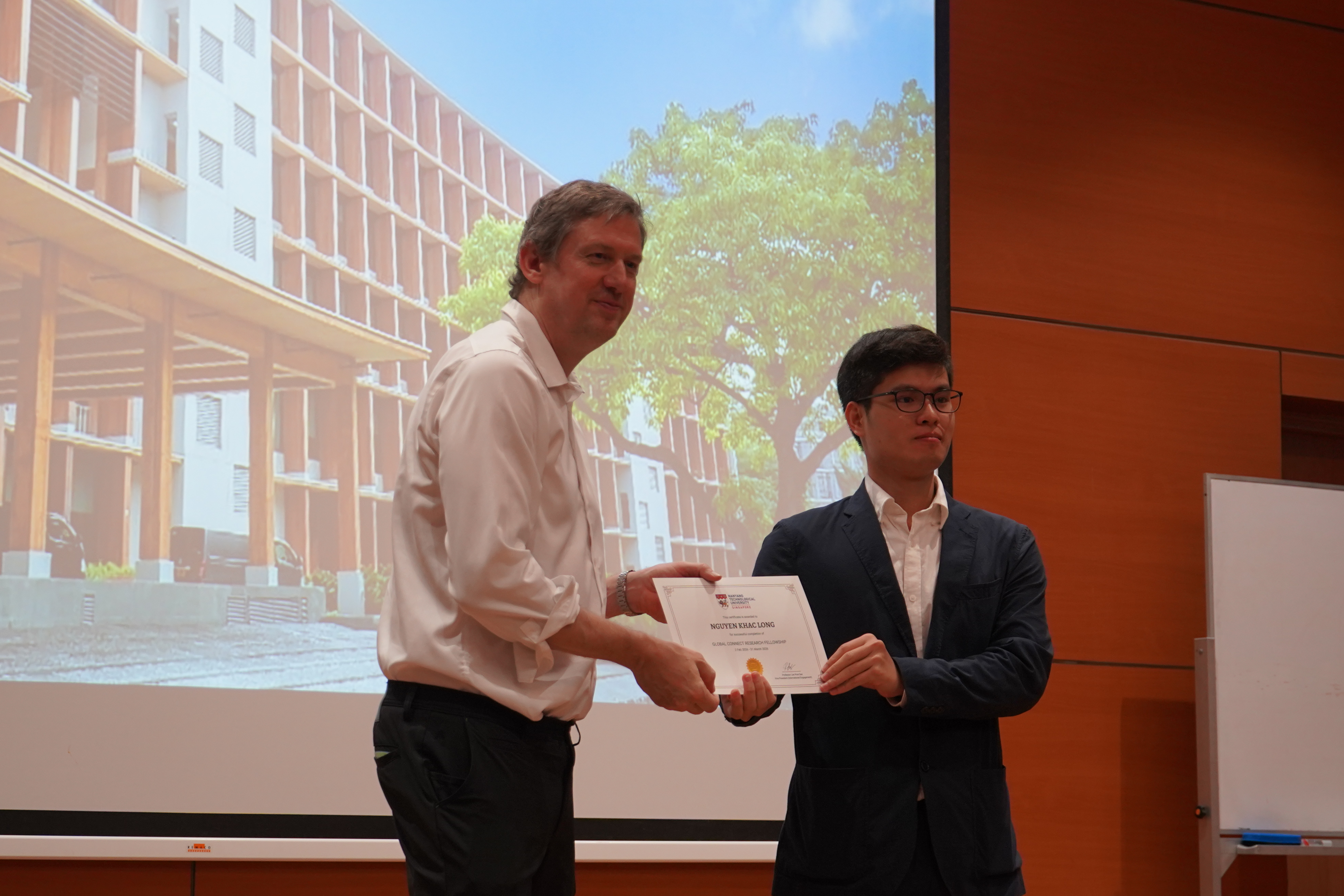
I was honored to receive the Most Popular Poster Award during the fellowship. This award was very meaningful to me, not only as recognition of my work, but also as encouragement to continue developing my research direction.
It reminded me that research communication is an essential part of academic work. A good idea becomes more valuable when it can be shared clearly, discussed openly, and connected with the interests of a broader community.
What I Gained from the Program
Looking back, the NTU Global Connect Fellowship gave me several important outcomes.
First, it strengthened my technical understanding of wireless power transfer systems for AUVs. I gained exposure to research problems related to underwater charging, relay coil design, system efficiency, mechanical integration, and communication between subsystems.
Second, it helped me develop a system-level perspective. I learned that advanced robotic systems must be studied as integrated systems rather than isolated components. This perspective is especially important for AUVs, where mechanical structure, control, sensing, energy, and communication are closely connected.
Third, it changed my research mindset. I became more aware of the importance of asking meaningful questions, understanding real-world constraints, and identifying research gaps. I also learned to think more critically when reading papers and designing research plans.
Fourth, the fellowship expanded my academic network. Connecting with professors, seniors, PhD students, and young scholars from different universities gave me valuable inspiration and guidance. It also helped me feel more connected to the international research community.
Finally, the experience gave me more confidence in my long-term academic path. It confirmed my interest in robotics, autonomous systems, underwater vehicles, and wireless power transfer.
Plans After the Fellowship
After completing the NTU Global Connect Fellowship, I plan to continue developing this research direction as part of my final-year project and future academic work. My next goal is to further investigate the integration of AUV control systems and underwater wireless power transfer.
In the short term, I aim to deepen my understanding of AUV dynamics, control strategies, and wireless charging architectures. I also plan to study different control methods, including PID control, sliding mode control, model predictive control, and intelligent control methods, to improve the stability and autonomy of underwater robotic systems.
In parallel, I want to continue exploring wireless power transfer designs that are suitable for practical AUV applications. This includes studying planar transmitter structures, receiver coil design, relay-coil-assisted configurations, alignment tolerance, and charging efficiency under realistic underwater conditions.
In the long term, I hope to develop this topic into a more complete research direction that combines mechanical design, control, wireless power transfer, and intelligent autonomy for underwater robotic systems. My experience at NTU gave me a clearer vision of this path and motivated me to continue improving myself as a young researcher.
Reflection
The NTU Global Connect Fellowship was one of the most meaningful academic experiences I have had so far. It gave me the opportunity to work on an advanced research topic, experience an international research environment, expand my academic network, and rethink the way I approach research.
More importantly, it helped me understand that research is not only about solving technical problems. It is also about asking better questions, connecting ideas across disciplines, learning from others, and contributing to a larger scientific community.
This experience will continue to shape my academic journey in robotics, autonomous systems, and underwater wireless power transfer. I am grateful for the opportunity, the mentorship, the friendships, and the inspiration I received throughout the program.
